STEM Charades
STEM Charades Early Years Pack (Ages 3-5)
STEM Charades Early Years Pack (Ages 3-5)

Highly Commended, STEM category, Teach Primary Awards 2026
Couldn't load pickup availability
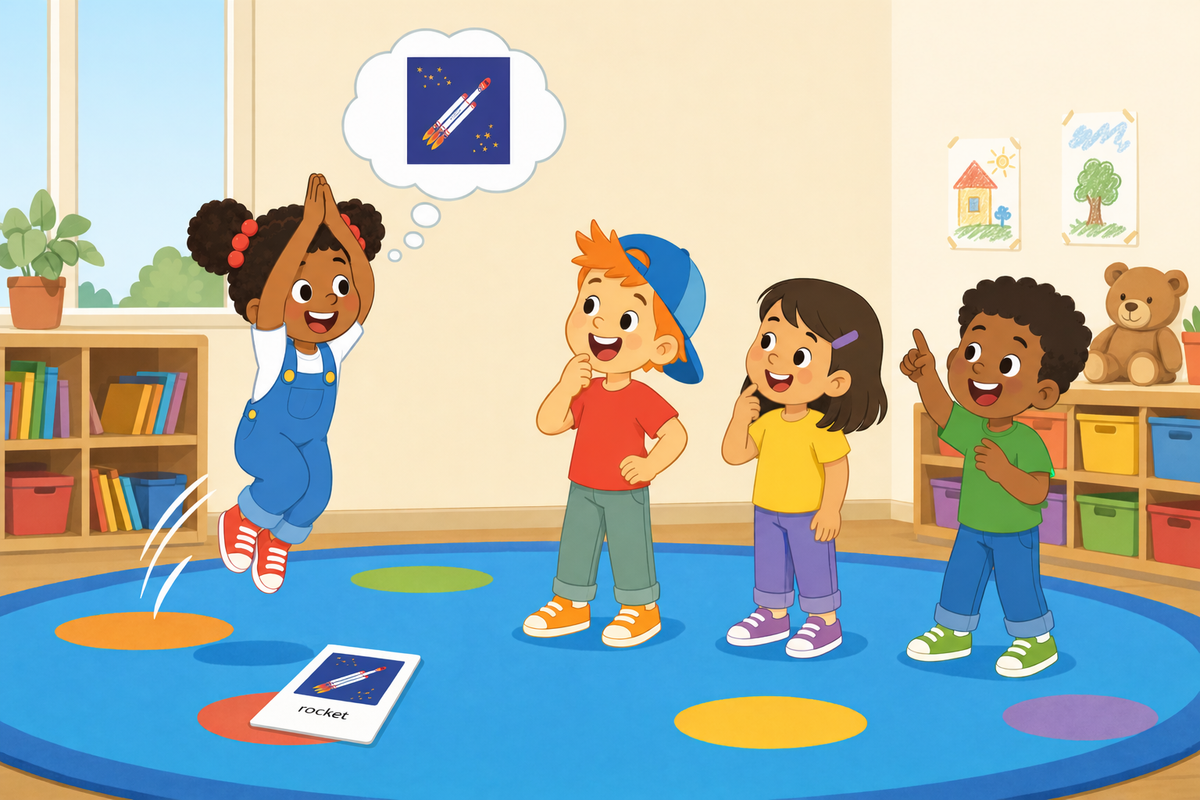
Children pick a card, act it out and say what they know while the others guess. The 30 picture cards are the easiest (one-dot) cards from our Science, Maths, Planet Earth and Computing packs, chosen for nursery and Reception.
Highly Commended, STEM category, Teach Primary Awards 2026
Pre-order: dispatching from 1 December 2026. 10 available.
At a glance
- 30 picture cards for ages 3-5 (nursery and Reception).
- The easiest cards from the Science, Maths, Planet Earth and Computing packs.
- Children act the card out, describe it in words, or do both.
- 2-4+ players. A game takes about 20 minutes.
- Designed by Professor Andrew Manches, University of Edinburgh.
What's inside
30 picture cards and an instruction leaflet.
- Science (11): spinning, stretching, squashing, balance, freezing, grow, wind, sun, rocket, bird, dinosaur
- Maths (8): count, add, subtract, halve, shapes, money, length, direction
- Planet Earth (7): animals, fish, insects, plants, ocean, storm, earth
- Computing (4): robot, computer, touch screen, instructions
How to play
- Pick a card. Do not show it to anyone.
- Describe the card. For "spinning", spin round. For "bird", flap your arms.
- The other players guess.
- Show the card and talk about it together.
Three ways to describe a card
- Gestures only. Act it out without speaking.
- Talking only. Describe it in words.
- Gestures and talking. Act it out and describe it at the same time.
FAQs
What ages is it for?
Ages 3-5, which covers nursery and Reception. It is not for children under 3.
How many can play?
2-4+ players.
How long does a game take?
About 20 minutes.
When will my pack arrive?
This is a pre-order. Packs dispatch from 1 December 2026. There are 10 available. Questions to info@playtalklearn.co.uk.
How is it different from the other STEM Charades packs?
The Early Years pack is for ages 3-5. It has 30 picture cards, the easiest ones from the Science, Maths, Planet Earth and Computing packs.
From the research
Ever noticed your hands moving when you explain an idea to a child? When teachers and children explain science ideas, they often gesture without noticing. In the Move2Learn project, we watched more than 500 children aged 3-8 explain science in science centres. Their hands often got there before their words.
Younger children's gestures often came before they could put an idea into words. Some children simply re-enacted what they had done. Others used their hands to show the process underneath, such as how distance from the pivot affects balance. Children can show what they understand through gesture before they can say it.
What might this mean for your children?
- Look for their understanding beyond words, especially in their gestures.
- Give them meaningful sensory and movement experiences.
- Use gesture as well as speech when you explain ideas to them.
STEM Charades grew out of this work, through online workshops with ten UK primary teachers.
Talk and gesture (oracy)
The Voice 21 Oracy Framework, from Voice 21 and Oracy Cambridge, has four strands: physical, linguistic, cognitive, and social and emotional. The physical strand includes gesture and body language. Its early years objectives include "to use gesture to support meaning in play" and "to use talk in play to practise new vocabulary". Acting out a card such as "stretching" or "storm" uses gesture in play. Naming a card such as "halve", "freezing" or "direction" uses talk in play with new words. The social and emotional strand includes turn-taking and listening, which are part of every round.
STEM Charades is not endorsed by Voice 21. We show where the game's activities sit in the framework. We do not claim any measured outcome.
Professor Andrew Manches, University of Edinburgh. Professor of Children and Technology. He taught in primary schools for eight years before moving into research.
Sources: Move2Learn (University of Edinburgh); Manches and Mitchell, Journal of Emergent Science, issue 24 (January 2023); Voice 21 Oracy Framework (Voice 21 / Oracy Cambridge).